Gathering bio, albums and tour dates…

Upcoming concerts
No concerts announced. Track Pussy Riot and they'll show up in My concerts as soon as they're announced.
Find Pussy Riot tickets
Prices and fees differ between sellers. Each opens in a new tab.
- Ticketmaster ↗Official tickets
- Vivid Seats ↗Resale
- StubHub ↗Resale
- SeatGeek ↗Resale
- TickPick ↗No buyer fees
- TicketNetwork ↗Resale
- Ticket Liquidator ↗Sold-out shows
- Gametime ↗Last minute
zaboomba may earn a commission when you buy through these links. It doesn't change the price you pay.
About
Pussy Riot is a Russian feminist punk rock protest group based in Moscow. Founded in August 2011, it has a variable membership of approximately 11 women ranging in age from about 20 to 33. The group stages unauthorised provocative guerrilla performances in unusual public locations, which are edited into music videos and posted on the Internet. The collective's lyrical themes include feminism, LGBT rights, and opposition to Russian President Vladimir Putin, whom the group considers a dictator, and to his links with the leadership of the Russian Orthodox Church. On February 21, 2012, five members of the group staged a performance in Moscow's Cathedral of Christ the Savior. The group's actions were eventually stopped by church security officials. By that evening, the collective had turned the performance into a music video entitled "Punk Prayer - Mother of God, Chase Putin Away!" The women said their protest was directed at the Orthodox Church leader's support for Putin during his election campaign. The head of the Russian Orthodox Church, Patriarch Kirill I, said the performers were doing the work of the devil. On March 3, 2012, two of the group members, Nadezhda Tolokonnikova and Maria Alyokhina, were arrested and charged with hooliganism. A third member, Yekaterina Samutsevich, was arrested on March 16. Denied bail, they were held in custody until their trial began in late July. On August 17, 2012, the three members were convicted of "hooliganism motivated by religious hatred", and each was sentenced to two years imprisonment. Two other members of the group, who escaped arrest after the February protest, reportedly left Russia fearing prosecution. On October 10, following an appeal, Samutsevich was freed on probation and her sentence suspended. The sentences of the other two women were upheld. In late October 2012, Alyokhina and Tolokonnikova were sent to separate prisons. The trial and sentence attracted considerable criticism, particularly in the West. The case was adopted by human rights groups including Amnesty International, which designated the women prisoners of conscience, and by a number of prominent entertainers. Public opinion in Russia was generally less sympathetic towards the women. Putin stated that the band had "undermined the moral foundations" of the nation and "got what they asked for". Prime Minister Dmitry Medvedev said he did not think the three members of Pussy Riot should have been sent to jail, but stressed that the release of the remaining two imprisoned members was a matter for the courts. Having served 21 months, Tolokonnikova and Alyokhina were released on December 23, 2013, after the State Duma approved an amnesty. In February 2014, a statement was made anonymously on behalf of some Pussy Riot members that both Alyokhina and Tolokonnikova were no longer members. However, both were among the group that performed as Pussy Riot during the Winter Olympics in Sochi, where group members were attacked with whips and pepper spray by Cossacks who were employed as security. On 6 March 2014, Nadezhda Tolokonnikova and Maria Alyokhina were assaulted and sprayed with green paint by local youths in Nizhny Novgorod.
Origins and musical style:
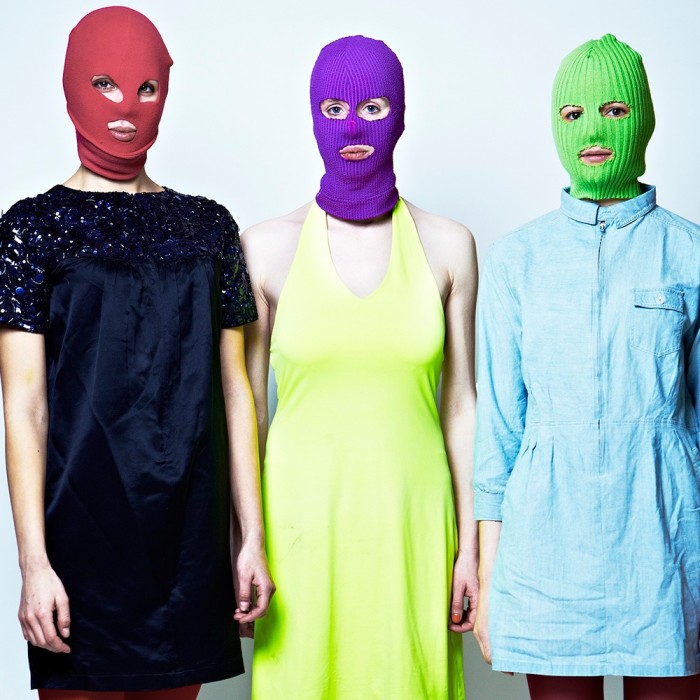
Pussy Riot formed as a collective in August 2011, and is usually considered an offshoot of the "Moscow faction" of the anarchist art collective "Voina". Nadezhda Tolokonnikova, her husband Pyotr Verzilov, and Yekaterina Samutsevich were all members of Voina, from the group's early days in 2007 until an acrimonious split in 2009. Following the split, the three formed a separate Moscow-based group, also named "Voina", saying they had as much right to use the name as Voina founder Oleg Vorotnikov. "Pussy Riot" is an English name, and is written in the Latin rather than Cyrillic alphabet. It usually appears as such in the Russian press, but sometimes is transliterated as "Пусси Райот". The collective comprises around 11 performers and about 15 people who handle the technical work of shooting and editing the group's videos, which are posted on the Internet. The group's costumes are usually brightly colored dresses and tights, even in bitterly cold weather, with performers' faces masked by balaclavas, both while performing and during interviews. During interviews collective members use nicknames such as "Balaclava", "Cat", "Seraph", "Terminator", and "Blondie". In an interview with Gazeta.ru, a band member described their two-minute concerts as performance art, creating images of "pure protest, saying: super heroes in balaclavas and acid bright tights seize public space in Moscow." Another band member, who goes by the pseudonym Garadzha, told the Moskovskiye Novosti newspaper that the group is open to women recruits with limited musical talents. She said: "You don't have to sing very well. It's punk. You just scream a lot." The group cites punk rock and Oi! bands Angelic Upstarts, Cockney Rejects, Sham 69 and The 4-Skins as their main musical influences. The band also cite American punk rock band Bikini Kill, performance artist Karen Finley and the riot grrrl movement of the 1990s as inspirations. The group stated:
What we have in common is impudence, politically loaded lyrics, the importance of feminist discourse and a non-standard female image. The difference is that Bikini Kill performed at specific music venues, while we hold unsanctioned concerts. On the whole, Riot Grrrl was closely linked to Western cultural institutions, whose equivalents don't exist in Russia.
Ideology: The musical performance group was organized, in part, due to anger over what members saw as government policies that discriminate against women, citing legislation that "placed restrictions on legal abortions". According to Tolokonnikova, Pussy Riot is "part of the global anti-capitalist movement, which consists of anarchists, Trotskyists, feminists and autonomists." Pussy Riot uses Situationist-style guerrilla performances. Tolokonnikova stated:
Pussy Riot's performances can either be called dissident art or political action that engages art forms. Either way, our performances are a kind of civic activity amidst the repressions of a corporate political system that directs its power against basic human rights and civil and political liberties.
Biography: TheAudioDB
Albums



Discography: MusicBrainz. Cover art: iTunes, Deezer & Cover Art Archive.